
In short
Preferred installation is with flow vertically up. This ensures the meter is always completely full of process fluid. This installation minimises wear of the liner by abrasive particles.
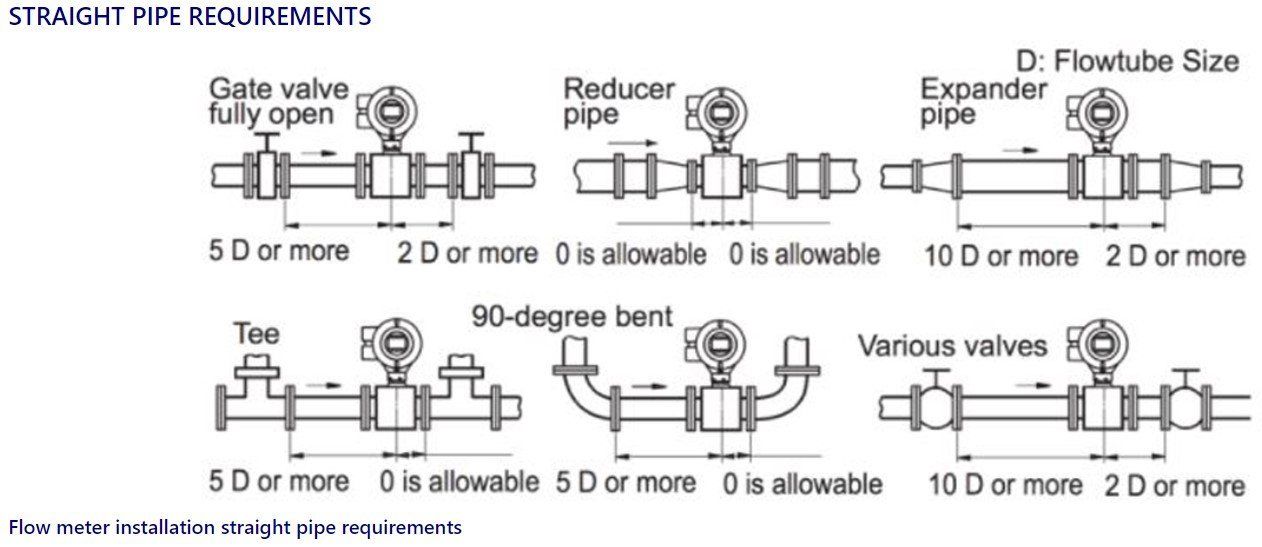
Horizontal flow is acceptable subject to the meter being kept full by an upstand in the downstream pipework. Horizontal applications require certain minimum straight lengths of pipe work before & after the flow meter.
In horizontal & sloping installations electrodes should be orientated so they are not at the top of the pipe. This will avoid entrained air or gases affecting the accuracy of the measurement.
When possible meters should be lifted with lifting lugs or shackles in the flange bolt holes. If this is not possible then soft slings should be wrapped around each end of the body to provide lifting points.
All flow meters which measure flow velocity perform best when the flowing fluid has a fully developed flow profile this generally occurs when the reynolds number is above 4500. Flow profile distortion & swirl can significantly degrade the accuracy & performance of all meters using this principle. These problems are often the results of practical requirements of the piping system such as, valves, tees, elbows etc. The full bore magnetic flowmeter is less susceptible to these adverse conditions than some other technologies. However the diagram above specifies the minimum straight lengths of piping that should be provided to allow the flow profile to stabilise after these typical flow disturbances. Whilst acknowledging the difficulties of achieving these straight length recommendations, particularly in large bore pipes, the less the compromises of the installation the better the performance of the meter will be.
- A vacuum release valve fitted at the high point of a vertical drain line will allow it to drain after the pump has stopped
- A sloping pipe with an upward flow is also a recommended installation
- Adequate pipe support must be provided either side of the meter


