All so known as a rotameter, these simple indicators give a repeatable measurement of flow rate for clear liquids & low-pressure air or gas. They consist of an float in a stainless steel tapered tube, as the flow rate increases the float rises in the tube, the float is magnetically coupled to a needle mechanism in the external indicator. The mechanism rotates the needle so the flow rate can be read directly from the scale.
This type of meter is always installed in a vertical section of pipe with the fluid flow upwards. There are no requirements for straight runs of pipe at the inlet or outlet of the meter because of the operating principle of the instrument. Stable flow will assist in the convenience of reading the flowrate & extend the working life of the device. The Mercon meter is available with a number of alternative connection configurations so that the float is orientated vertically regardless of the process pipework arrangement.
There are 2 upward forces on the float, the drag force from flowing liquid and the buoyancy force due to the difference in density between liquid and the float.
There is a downward force due to the weight of the float. In practice the only variable is the drag force, so as the flow rate increases the float rises in the tapered tube increasing the area of the annulus at the position of the float. Hence the float reaches a point of equilibrium when this increase in area creates a balance of the forces on the float.
These names are interchangeable, variable area flow meter best describes the operating principle of the device. Rotameter is the registered brand name of a prominent manufacturer of these instruments.
They are simple devices that do not require any electrical power, so they are cheap to install in remote or hazardous areas. They do not require straight lengths of pipe at the inlet or outlet, so the installation is compact and economical. They have a linear scale; they are reasonably accurate and give very repeatable results. They can be fitted with digital indicators and 4 -20mA output to give a remote indication of flow rate.
Because of their robust construction this type of meter can operate at high pressures & temperatures. Each instrument is individually calibrated to the specfic gravity of the process fluid. These features enable the meter to provide low cost flow measurement to applications normally reserved for expensive coriollis type mass flow meters such as high temperature oils etc.
- No power required, can be used in hazadous zones
- Only 304 stainless steel in contact with process fluid, other wetted material options are available
- Compact installation as no straight pipe is required at inlet or outlet
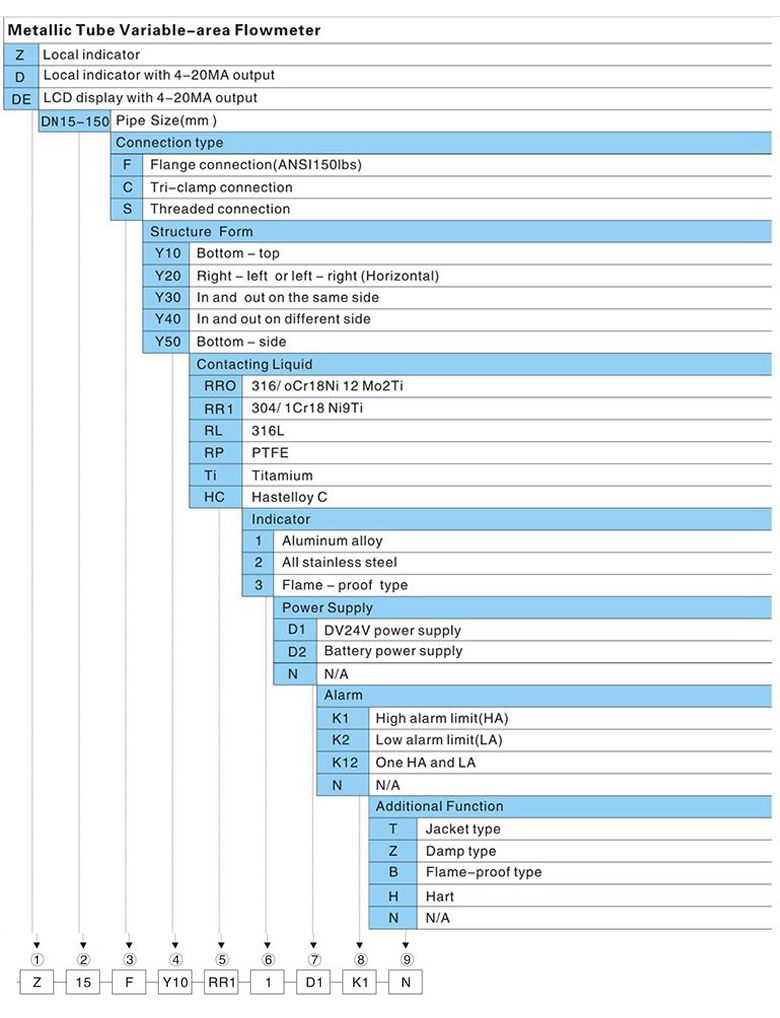
- Pipe size DN15 to DN150
- Measuring range: Water (20ºC) 2.5 to 10000 L/H, air (20°C, 1 bar) 0.07 to 750 M³/H
- Turndown ratio 10:1
- Suitable for high working pressures & temperatures
- Suitable for viscous fluids
- Suitable for opaque and turbid fluids
- Optional connections include flange, tri clover clamp, female BSP threads
- Linear scale
- Negligble & constant pressure loss
- Accuracy ±2.5% or ±1.5% optional
- Optional switches for low and high flow alarms
- Optional 4 – 20mA analogue output
- MTVAF ranges
- What is a variable area flow meter?
- How should a variable area flow meter be installed?
- What is the working principle of the vatiable area flow meter?
- VAF principle of operation
- It is important that the manufacturer is aware of the density of the liquid for accurate calibration of flow rate
- What is the difference between a rotameter and a variable area flow meter?
- What are the advantages of a variable area flow meter?
- What applications use metal bodied variable area flow meters?
- Contact us for pricing